
Reflective Scientific Advisory Board: 2025 Meeting Report

Reflective’s Scientific Advisory Board (SAB) met in November 2025 to review current projects and discuss future priorities. The meeting had two main goals: (1) solicit strategic input on Reflective’s ongoing work, and (2) seek guidance on prioritization of the most critical SAI research areas.
Several themes emerged in these discussions:
Increasing interest in SRM raises the bar for rigor and timeliness, rather than justifying a slower or more cautious approach to research. Transparency is a precondition for credible research. The newly released Uncertainty Database can focus attention, funding, and effort where uncertainty and decision-relevance are highest.
SRM research should be cognizant of the needs of specific climate assessment processes and national policy decisions.
Evaluating the outputs of comprehensive climate models—even across large ensembles—is insufficient to resolve several of the most decision-relevant uncertainties in SRM. Instead, a portfolio of approaches will be required.
For a subset of high-impact uncertainties, conducting outdoor experiments is likely the only scientifically credible way to generate needed evidence. Such experiments could range from very small scale balloon experiments with no material released to much larger experiments with injection of aerosol precursors.
The rest of this document describes the primary conclusions from the SAB meeting regarding priority research areas, methodology and scenario framing for the uncertainty database, and a few other topics.
Priority Research Areas/Activities
A key goal of the meeting was to consult the SAB on the most important research priorities in SAI. During the meeting, the SAB brainstormed potential research activities, then grouped and prioritized them. Afterward, the Reflective team further consolidated these inputs into five highest-priority areas. These priorities will strongly inform Reflective’s funding decisions over the next one to two years, though they do not represent a firm strategic commitment. The five areas are:
more comprehensive assessment of SAI impacts,
analysis of SAI’s interaction with tipping points,
evaluating feasibility and utility of an outdoor experiment to understand aerosol processes,
modeling of stratospheric aerosol processes at scales <10 km, and
design of observational systems.
Each is described in more detail below.
Additional Evaluation of SAI Impacts and Underlying Mechanisms
Description: Research on the Earth-system response to SAI, including extreme weather, wildfires, air quality, crops, etc.
Why is this important? While there has been some research into the impacts of SAI, more comprehensive analyses are required. To increase confidence in results, studies that analyze many impacts under the same scenarios in multiple models are needed, as well as studies on certain impacts that are under-studied. This is particularly relevant for climate assessment activities.
Potential research activities:
Comprehensive review of impacts using additional SAI model runs (GeoMIP’s G6-1.5K-SAI and Reflective’s HiLLA simulations).
Analysis of the main climatic drivers behind specific impacts in models or with volcanic analogues (e.g., Do changes to the Atlantic Meridional Overturning Circulation (AMOC) scale primarily with global temperatures or polar temperatures?)
SAI Interaction with Tipping Points
Description: A related, but distinct set of research questions specifically about SAI’s ability to prevent or compensate for strong nonlinearities in certain earth system elements.
Why is this important? SAI has potentially unique preventative possibilities for tipping elements that could substantively affect decisions to deploy. The effects of SAI are not directly inter-comparable with those from other methods of climate forcing because different spatial patterns and time variability can be specifically targeted. Tipping elements are themselves critically important, as these often relate to the acceleration of global warming or its impacts (the melting of permafrost, for example.)
Potential research activities:
Modeling of whether SAI can prevent certain tipping points, as well as what injection scenarios could be most effective at this
Analysis of greenhouse gas concentrations and temperatures as distinct independent variables in existing tipping point threshold analysis
Note: These first two priority research areas are the subject of an RFP Reflective put out in early February.
Assessing Viability of and Designing an Outdoor Aerosol Process Experiment
Description: A feasibility assessment to understand whether an outdoor experiment that would meaningfully reduce uncertainty about aerosol processes could be conducted safely and transparently. This research category encompasses the scientific design and rationale for an experiment as well as work to determine how to perform it, including research on aircraft, disbursement technology, ground infrastructure, observational capabilities and requirements, safety, and public engagement and oversight process.
Why is this important? Some of the most important technical uncertainties in SAI — aerosol size evolution, plume dynamics, and microphysics — cannot be resolved in models or laboratory studies alone. There is a large amount of feasibility and design work required prior to any experiment to understand the real engineering, regulatory, safety, cost, and governance requirements. Doing this early, openly, and rigorously reduces the risk of poorly designed or poorly governed experiments.
Potential research activities:
Analysis of how much the uncertainty in aerosol size distribution matters for our understanding of SAI efficacy and deployment decisions and what observations could usefully constrain the aerosol size distribution under different atmospheric conditions and precursor concentrations to inform microphysical models.
Studies to evaluate candidate aircraft platforms and modification pathways.
Aerosol precursor disbursement mechanism technology studies
Safety analysis of storage and handling of SO2 on the ground and onboard an aircraft. Note: Reflective is targeting this activity to be resolved Q2 2026.
Additional SAB feedback: Because Reflective has been actively working on designing an outdoor experiment with the goal of understanding the scope for time and budget, we spent some additional time discussing these ongoing efforts. Although the discussion did not tackle many aspects of carrying out the experiment, it touched on several important points including:
Experiments need to be clearly justified and designed specifically to address the uncertainties about aerosol microphysics.
Experiments are not a commitment to deploy even though they will require development of technology critical for deployment, and negative results are extremely valuable.
Analogue-type measurement experiments were highlighted as potentially promising, including developing a plan for a quick turnaround to sample a volcanic eruption or rocket plume.
Modeling of Scales from Microphysics to Grid Scale
Description: Developing new modeling capabilities to connect the smallest scales of microphysics and chemistry to the climate model grid scale (around 10-25 km).
Why is this important? The accuracy of climate models’ predictions of the response to a particular injection amount is limited by the underlying assumptions of the chemistry, aerosol evolution, and radiative properties, which are typically assumed to be uniform across the grid cell (100km x 100km x 1km, at most). Given that chemical reaction rates and the processes driving aerosol size evolution are nonlinear, the resulting distributions of species and sizes can differ strongly for uniform vs. nonuniform concentrations within the grid. Resolving smaller scales will thus enable us to understand what is happening at the sub-grid level, understanding the relevance of previously uncaptured interactions, and ultimately providing more realistic radiative forcing inputs for models.
Potential research activities:
Analysis of how SO2 or other aerosol precursor spreads immediately in the wake of a plane
Development of modeling techniques that accurately describe plume spread becoming grid scale.
Modeling of microphysics with a variety of precursor concentrations and incorporating simplified and more detailed chemistry
Exploration of ML emulators for subgrid mixing
Observational Monitoring Requirements and Capabilities
Description: Research and analysis of the required baseline and observational data, and development of the required instruments for collecting this data by experimental scale.
Why is this important? Sufficient observational capabilities are essential for everything from the experimental to deployment scales. Since these instruments and missions often have long development lead times, it is essential to begin research in the near-term on what measurements and instruments are necessary.
Potential research activities:
Define specifications for in-situ and satellite observations at experimental to early deployment scale
Development of smaller, cheaper sensors than traditional satellites for monitoring
Establish aerosol and composition background in the lower to mid stratosphere (up to 25 km)
Perform modeling studies to determine what satellite observations would be necessary to detect SAI with different scenarios
Uncertainty Database
Equipping the world with the data and tools needed to make informed decisions about SAI, fast enough to matter, requires a shared view of what uncertainties matter for real-world decisions and what it would take to address each.
Our hypothesis is that a prioritized, scientifically-grounded roadmap for SAI research will enable:
Researchers to select projects that answer the most decision-relevant questions.
Funders to build portfolios that systematically reduce the most pressing uncertainties.
Policymakers to see where the science is strong, where it’s limited, and what it would take to improve it.
The Uncertainty Database is a first step towards that roadmap. Each uncertainty is ranked by level of uncertainty and decision-relevance, allowing us to rigorously prioritize work that may change decision-making. The database also indicates what can be done to reduce the uncertainty and, for uncertainties that can only be reduced through perturbative experiments, indicates what scale of experiments may be needed to address these uncertainties. This provides the foundation for sequencing and stage-gating research, such that the information relevant to decision making is available as soon as possible.
At last year’s SAB meeting, the group assessed key uncertainties and outlined a methodology for categorizing core technical uncertainties—both related to the climate/earth-system and to engineering—associated with SAI. Since then, Reflective’s team has scoured the literature to add further depth to that database (read more about the methodology here).
Before the SAB meeting, Reflective conducted a targeted feedback round from researchers in the field and incorporated revisions. The SAB meeting provided an opportunity to review that feedback, align on terminology and messaging, dig deeper into specific uncertainties and research activities, and discuss how–both logistically and scientifically–future comments will be addressed and incorporated.
The main points are summarized below:
Scenario Assumption Framing
Because the decision relevance of uncertainties depends on what specific decision is being made, we have defined a scenario—material, injection latitude and altitude, and target cooling rate—as the basis for populating the database. The SAB raised two critiques:
Scenario dependence is itself a key uncertainty, and excluding it risks presenting an incomplete picture.
Given that some constraints are necessary, the rationale for the chosen scenario and its timing should be communicated more clearly and in greater detail.
To address the first point, we explored several ways to better represent scenario-related uncertainty. While our priority remains releasing the UDB promptly, we will seriously consider incorporating some or all of the following in a second version:
A scenario-specific uncertainty category to explicitly surface this issue, even if it does not perfectly align with the current framework.
A “scenario-dependence” note for each uncertainty, indicating how its quantification and diagnostics themselves might change across scenarios. This could alternatively be integrated into the “climate impacts” view under development.
Support for viewing the database across multiple scenarios, which would require substantial additional work and is therefore a longer-term goal.
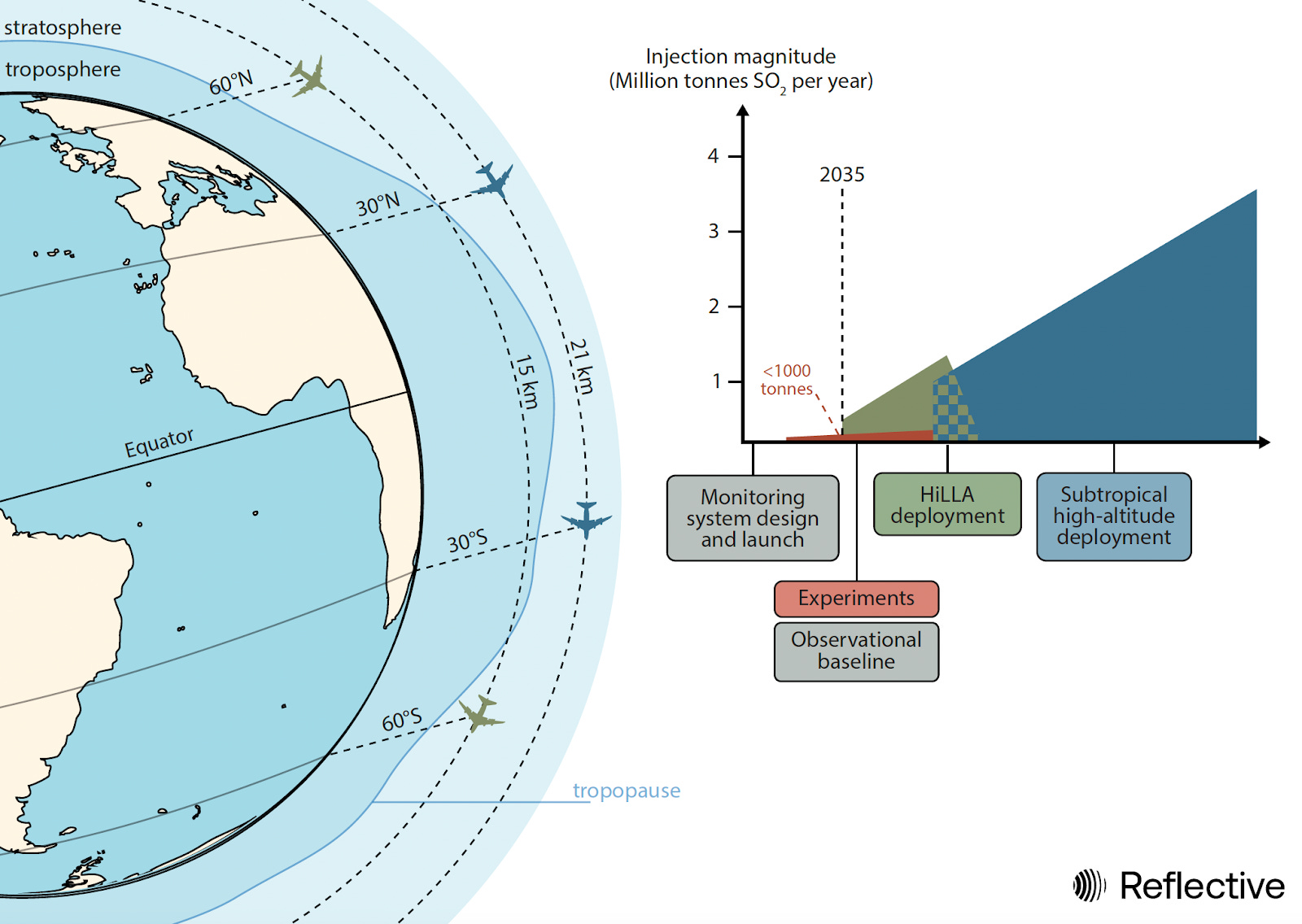
To address the second critique, we are revising our language to clearly explain the scenario assumptions and our reasons for using them. Based on SAB input, we created a diagram illustrating these assumptions (see below) and will highlight explicitly that the scenario itself is an important source of uncertainty.
“Decision-Relevance” Framing
The metric now called “decision-relevance” (i.e. the Y-axis of the database) was previously labeled “degree of consequence.” The longer description explained that this quantification is intended to reflect the impact that being wrong about a given uncertainty would have on the cost-benefit of a future decision to deploy. The SAB raised two main concerns with this language:
“Consequence” is vague and not easily understood without reading the full methodology.
Language centered on “deployment” risked oversimplifying the decision-making process.
Based on this discussion, we changed the shorthand label for the Y-axis to “decision-relevance,” improving clarity without sacrificing concision. We also switched the more detailed description to explain that this quantification focuses on how much being wrong about a given uncertainty impacts informed decision-making. This change better communicates that resolving technical uncertainties is only one component of broader decision processes.
Expert Solicitation
We also received feedback on how to develop the database going forwards to increase accuracy, reliability, and depth. Specifically, expert workshops targeting each category of uncertainty were suggested, potentially including structured, expert elicitation to give quantitative information on our assignments of level of uncertainty and decision relevance. We will conduct these workshops over 2026-2027 in support of several review paper-style publications and will update the UDB accordingly.
Additional Feedback
More broadly, the SAB encouraged clearer messaging about the scope and limitations of the UDB. In particular, they recommended adding language to avoid unintentionally implying that technical uncertainties are the only factors relevant to future decision-making. This includes acknowledging the importance of non-technical uncertainties and noting that this first version of the UDB involves some inherent subjectivity.
 | A guest post by
|