
Sunlight reflection options: a quick primer (and why Reflective prioritizes SAI)

The basic idea: Earth’s energy balance has “two sides.”
Earth’s temperature is set by an energy balance: how much incoming sunlight is absorbed versus how much heat (infrared radiation) escapes to space. Historically, about 30% of incoming sunlight is reflected back to space by clouds, aerosols, and bright surfaces; the rest is absorbed and must be balanced by outgoing heat.
Most climate policy has focused on the “outgoing” side of the ledger: greenhouse gases trap heat by reducing how efficiently Earth can shed infrared radiation to space. Because that mechanism is well established and directly tied to human emissions, it has (appropriately) dominated climate policy and investment. It’s also why carbon removal matters: it’s one of the only ways to bring atmospheric concentrations back down. But recent work also emphasizes changes on the incoming side: satellite-era evidence suggests Earth has become less reflective, increasing absorbed solar radiation on the order of ~1.7 W/m² over recent decades—large enough to matter for the pace of warming.1
Sunlight reflection (aka solar radiation modification or solar geoengineering) refers to proposals that would increase the amount of sunlight reflected back to space—affecting the other side of the ledger—to offset this decline in reflectivity and partially counter warming. SRM would not remove CO₂ or reverse all climate impacts, and it would not perfectly restore a preindustrial climate; regional responses would differ. But modeling suggests that “if deployed in an informed and globally coordinated way, SRM could ameliorate many, but not all, of the adverse impacts of climate change.”2
This primer summarizes the main SRM approaches discussed in major assessments and the tradeoffs that shape what each approach might plausibly be used for.
What are the main sunlight reflection options?
Major scientific assessments describe three main atmospheric sunlight-reflection approaches (shown below)—stratospheric aerosol injection (SAI), marine cloud brightening (MCB), and cirrus cloud thinning (CCT)—alongside more limited surface albedo modification methods and more speculative space-based concepts.
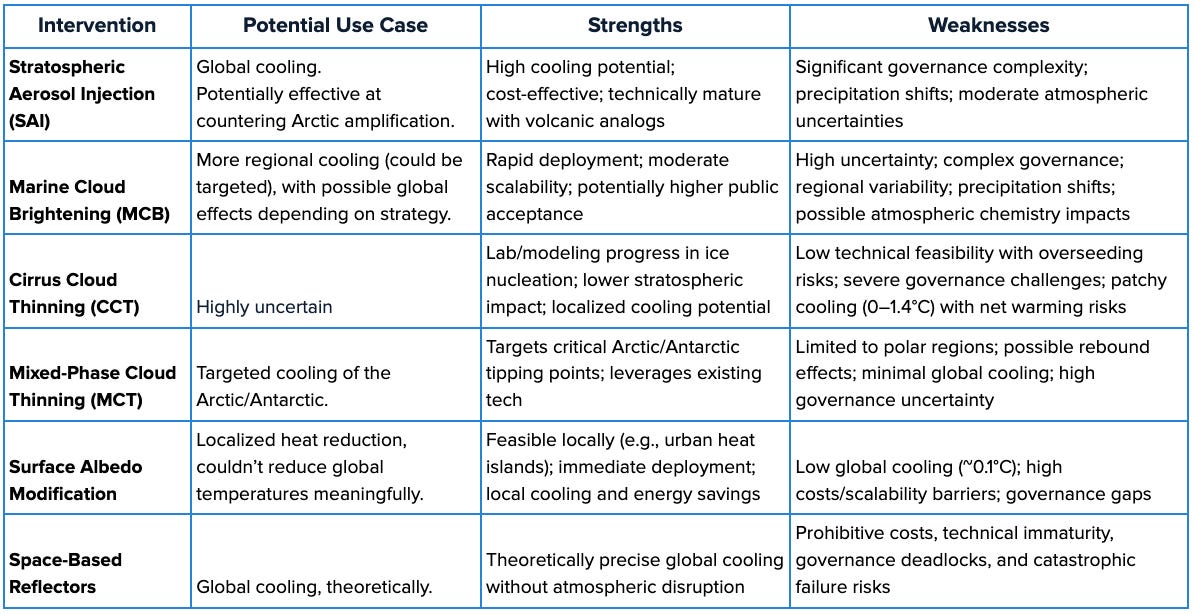
Different sunlight-reflection approaches fit different goals. Some interventions are best understood as targeted risk-reduction tools (e.g., reducing urban heat, protecting specific ecosystems, or moderating regional extremes). Others are candidates—at least in principle—for meaningful global-average cooling. If your objective is global cooling, SAI is the leading candidate. If your objective is more localized or near-term heat-risk reduction, other approaches may be more appropriate.
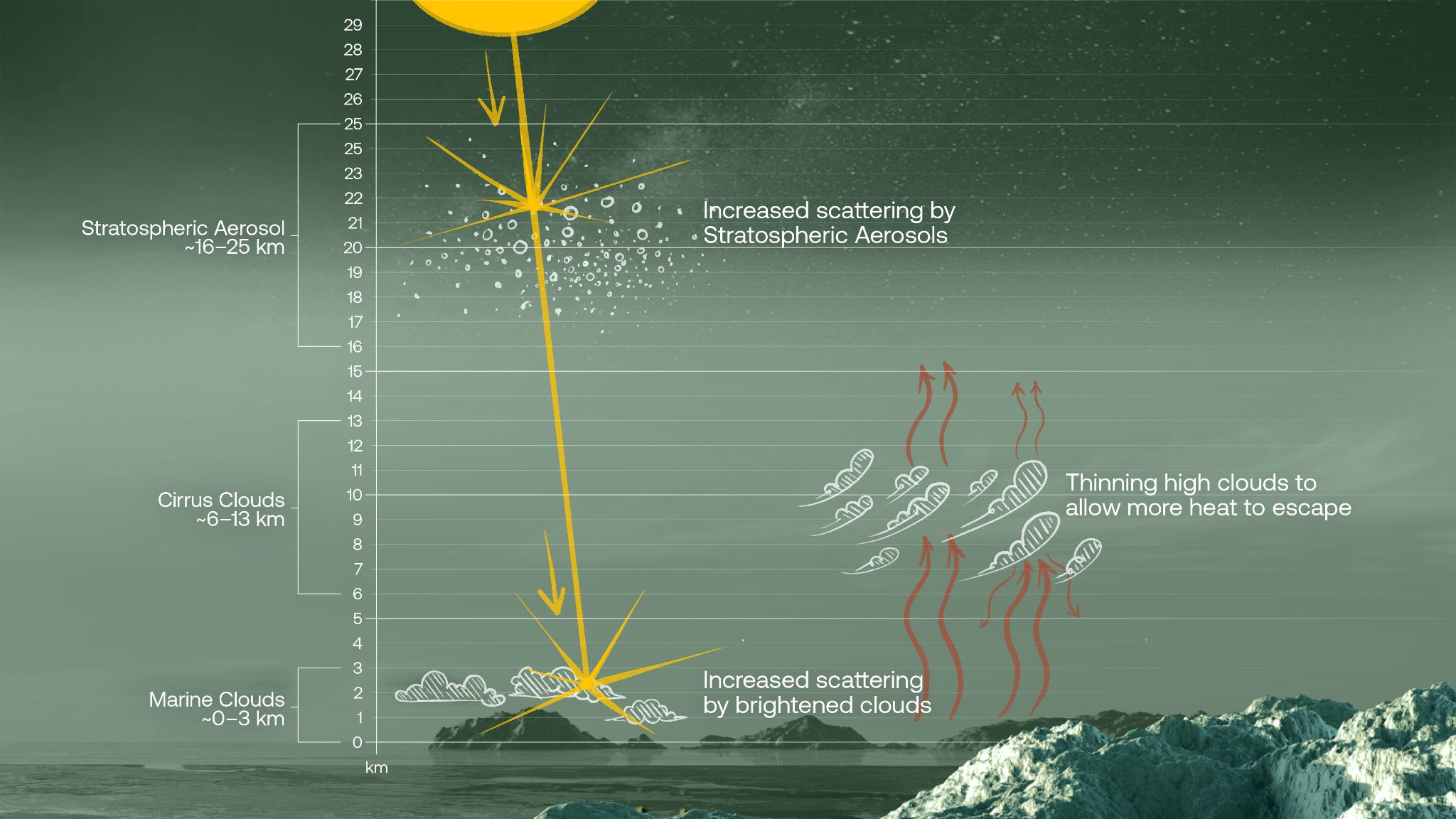
Stratospheric aerosol injection (SAI) proposes adding reflective aerosol particles—or their gaseous precursors—into the lower stratosphere (>8km at high latitudes, >20km in the tropics). The goal is to form aerosols in a size range that efficiently scatters incoming sunlight back to space. Done at sufficient scale, increased reflectivity could produce a measurable cooling influence on global mean temperature.
Sulfate aerosols are not the only candidate material, but they are the best understood in large part because sulfate SAI has a natural analogue: major volcanic eruptions. When Mt. Pinatubo erupted in 1991, it injected nearly 20 million tons of sulfur dioxide (SO₂) into the stratosphere; the resulting sulfate aerosol cloud spread globally and contributed to a temporary global cooling of about ~0.5°C over the following 1–2 years.
For context, industrial activity currently emits ~80 million tonnes of SO₂ per year into the lower atmosphere, where aerosols have a much shorter lifetime and are removed relatively quickly. In the stratosphere, aerosols persist longer (~1-2 yrs), so much smaller annual injections can, in principle, sustain a measurable cooling influence. While there is still significant model disagreement on the amount of material required to produce a given amount of cooling—and results depend on delivery strategy and aerosol properties—one estimate is that ~17–42.5 million tonnes of SO₂ per year delivered to the stratosphere would be in the range needed to counterbalance the observed decline in Earth’s reflectivity.
Marine cloud brightening (MCB) aims to increase the reflectivity of low-lying marine clouds by adding aerosols into the marine boundary layer (roughly the lowest ~0–3 km of the atmosphere over the ocean). Cloud droplets form around airborne particles (“cloud condensation nuclei”). In some cloud regimes, increasing the number of suitable particles can increase the number of droplets, making them smaller and—often—brighter, which can raise cloud reflectivity and create a cooling influence. MCB may be especially relevant for targeted cooling (i.e. ongoing work in Australia to cool and protect the Great Barrier Reef), but its ability to cool globally remains more uncertain.
Sea-salt particles are frequently discussed as a leading candidate for MCB because they are naturally present over oceans and are comparatively well understood as aerosol material in marine environments. Observations of ship tracks—bright linear features in marine clouds linked to aerosol emissions from ships—are often pointed to as a real-world illustration that aerosols can measurably change cloud brightness in the right conditions.
Cirrus cloud thinning (CCT) proposes reducing the warming effect of high-altitude cirrus clouds by altering their formation so that they are less extensive or shorter-lived, allowing more heat (infrared radiation) to escape to space. Strictly speaking, this is not “sunlight reflection” in the narrow sense—it targets the outgoing heat side of the energy balance rather than reflecting incoming sunlight. It is also a comparatively nascent area of study, with large uncertainties in basic effectiveness, side effects, and whether interventions would reliably produce net cooling.
Mixed phase cloud thinning (MCT) is a related, even newer proposal, which aims to modify the radiative properties of ice-liquid clouds, leveraging mature cloud seeding technologies to enhance ice nucleation. While theoretically capable of regionally significant cooling (~1°C in the Arctic), the global effect would be low.
Surface albedo modification refers to interventions that make parts of Earth’s surface more reflective—most commonly cool roofs/pavements in cities or land-surface changes that slightly brighten croplands—so those areas absorb less sunlight and heat up less. The strongest case is local heat-risk reduction (especially urban heat), not global cooling: data shows that reflective “cool roof” strategies can lower summer daytime city temperatures by roughly ~0.5–2°C (often more at the neighborhood scale). The constraint is scale and tradeoffs: to affect global mean temperature you would need sustained reflectivity changes over vast areas, while real-world limits (land use, ecology, glare, maintenance, and regional circulation effects) keep surface brightening in the category of targeted adaptation/heat mitigation rather than a leading candidate for broad, global cooling.
Space-based sunlight reflection refers to proposals that would reduce the amount of sunlight reaching Earth using objects in space—often framed as “sunshades” or “reflectors.” In principle, it could produce an even, global cooling influence without injecting material into the atmosphere. In practice, the scale is enormous: a 1% reduction in sunlight would require a total shade area on the order of ~3–4 million km²—comparable to the area of India. Classic proposals to offset warming by ~1.8% of solar flux imply millions of square kilometers of effective area. That scale drives daunting requirements for launch, deployment, station-keeping, resilience, and governance—one reason most near-term SRM research agendas focus on atmospheric approaches instead.
Why Reflective focuses on SAI
We expect growing demand by ~2030 for a rigorous assessment of at least one sunlight reflection approach that could plausibly deliver meaningful global cooling on a policy-relevant timeline. Given finite time and finite resources, we see prioritization and focus as a necessity: Reflective is concentrating on producing the data and tools required to rigorously assess sulfate SAI, which we believe is the most likely first candidate to be seriously considered.
If the objective is meaningful global cooling, SAI is the leading first-generation candidate. Some SRM approaches may be valuable as targeted risk-reduction tools—e.g., moderating local heat, protecting specific ecosystems, or exploring regionally scoped interventions. But if the question is whether an intervention can materially influence global mean temperature, SAI is one of the few approaches that is plausibly capable of doing so at scale and on relevant timelines.
SAI is the option most likely to be on the near-term decision agenda. Whether or not anyone wants SAI to ever be used, it is already the approach often treated—by scientific assessments, policymakers, and critics alike—as the “default” SRM concept that would need to be evaluated, bounded, or governed. That makes it the most decision-relevant place to concentrate effort if the goal is a credible, publicly legible assessment.
Sulfate is the most credible “gen1” aerosol because it has a natural analogue. Volcanic eruptions are not a perfect proxy for intentional deployment, but they provide real-world constraints on stratospheric sulfate aerosols and their climate effects—useful for bounding impacts and for designing monitoring and attribution.
Sulfate SAI has a tractable “critical path” to decision-relevant evidence. Initial outdoor experiments, far too small to cause any climate response, can reduce decision-critical uncertainties (e.g. aerosol microphysics, plume evolution, mixing and distribution) and build the operational capabilities – aircraft, instruments, safety systems – needed for a serious assessment.
“Gen2” shouldn’t outrun that critical path. More novel particles and approaches may eventually matter, but they add new unknowns in chemistry, feasibility, and monitoring. Given finite resources, our priority is to make sure the decision-critical work for “gen1” sulfate SAI is fully resourced and moving quickly; “gen2” becomes higher-leverage once that foundation is in place.
Focusing on SAI is not an endorsement; it’s prioritization under uncertainty and time pressure.
We are agnostic on whether SAI should ever be deployed—but we are not agnostic about the need for answers in time to matter. The existence of a plausible global-cooling candidate creates pressure—scientific, political, and reputational—for the research community to be able to say something more rigorous than “it’s controversial.” Our focus reflects urgency about building that evidentiary base, not a normative claim that SAI is desirable.
Marine cloud brightening and other proposals may be important—particularly for regional objectives, targeted heat-risk reduction, or near-term field learning. But because resources are finite, Reflective is concentrating on the global-cooling use case and on the pathway we believe is most likely to be demanded for rigorous evaluation.
Loeb, N.G., et al. (2021). “Satellite and Ocean Data Reveal Marked Increase in Earth’s Heating Rate.” Geophysical Research Letters, 48, e2021GL093047.
The Royal Society. Solar Radiation Modification: policy briefing. October 2025. [the document includes a footnote specifying: “The term ‘globally-coordinated’ refers to the need to deploy SRM in a scientifically-informed and coordinated, multilateral way in both hemispheres, with wide international agreement and with a commitment to maintaining SRM for decades or even centuries. This is by no means the only conceivable model of SRM implementation. Individual nations or entities might decide, in their own self-interest, to attempt SRM, which could lead to large regional climate effects that impacted on third parties.”]